
What is carne seca?
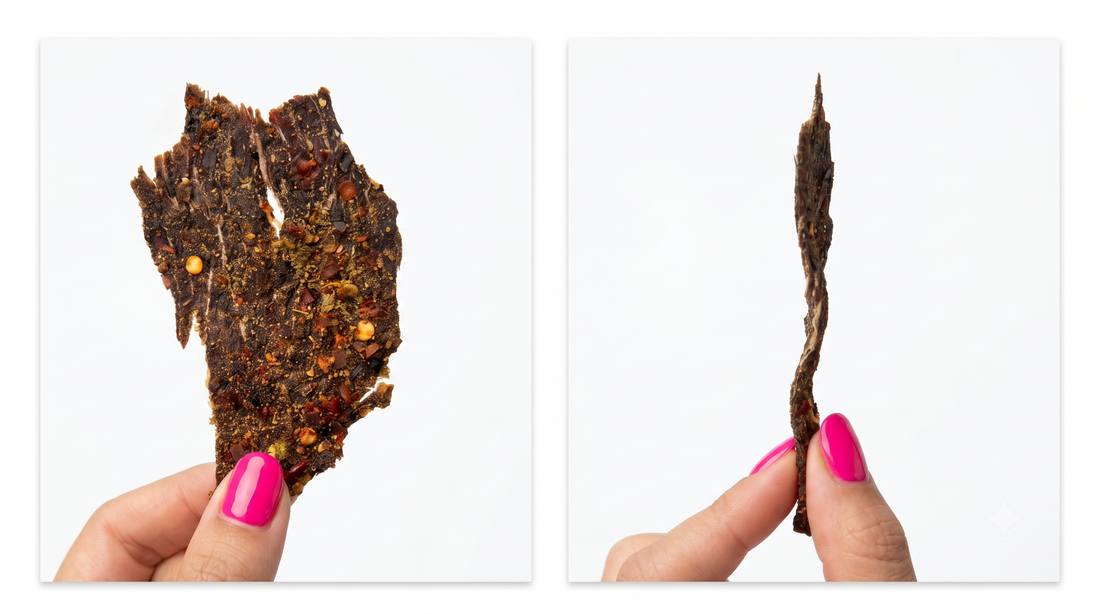
Carne seca is salted, thinly sliced lean beef, air-dried until crisp: a preservation tradition from northern Mexico and the U.S. Southwest. Most of Mexico rehydrates and cooks it; New Mexico keeps it dry, thin, and crispy and eats it as a snack. That crispy style is exactly what we make.
The name means “dry meat” in Spanish. Behind those two words sit a centuries-old desert cooking technique, a new food science, and a handful of different regional styles: from cotton-fine Sonoran machaca to the brittle, Hatch-chile-dusted New Mexico crisp in every GrazeOn bag.
Author's note — Albuquerque, NM
I'll be completely honest: there aren't many topics I can write about as an actual expert, a few computer science algorithms, maybe (I am a teaching assistant for Advanced Algorithms at CMU ☝️🤓). But as an Albuquerque New Mexican, the co-founder of a traditional carne seca jerky company, and a lifetime beef jerky hobbyist, I'm about as close to a beef jerky expert as it gets. Now, If you're not from the southwestern U.S. or northern Mexico, you may have never heard of carne seca. No problem. Today, I'm going in-depth into my own research and understanding of the history of the delicacy, the stark regional culture around how it's made, and the common misconceptions people (outside of the Southwest) have. Whether you read every word or just skim, I hope you learn a thing or two about our beloved cultural phenomenon, Carne Seca.
First, let me give some background on Carne Seca from a modern youth's perspective. Growing up in NM, everyone I knew had a beef jerky plug: someone selling dehydrated beef they made in their garage, or working off their grandma's secret recipe in the back of a restaurant. I remember being on a hike, or down at the University of New Mexico Duck Pond, and getting approached by strangers offering green chile beef jerky, or the harder stuff, like Hot Cheeto or Taki flavored beef jerky. They would approach you with a large tub of unlabeled bags filled with super-seasoned, thin beef jerky. Looking back, the whole NM carne seca scheme is wildly unique. There's literally no other product I'd be comfortable buying from a total stranger in a park, knowing that they made it in their garage and put it in little baggies (even if Heisenberg made it).
But because the meat is dried to an absolute crisp, the process quietly minimizes two risks: that the meat is undercooked or underprepared, and that it's old or gone bad. Jerky dried to this extent has a shelf life up to a year (probably longer, but that's what the FDA will commit to). Which makes the shady stranger selling beef in the park a surprisingly trustworthy food manufacturer, based on the texture and visuals of the product alone.
While carne seca and U.S. beef jerky share the fundamental process of dried meat, they possess entirely different culinary philosophies. American beef jerky has evolved into a highly processed, ready-to-eat snack commodity. The production of modern jerky typically involves complex liquid marinades containing soy sauce, brown sugar, teriyaki flavoring, garlic, and liquid smoke to artificially flavor the meat and maintain a pliable, chewy texture. In stark contrast, authentic carne seca utilizes a minimalist cure, often nothing more than salt and occasionally local chilies, and is dried until it is entirely stiff. That is why New Mexican's love Carne Seca, not only is it delicious, but it is simple. To clear something up:
To New Mexicans, carne seca is beef jerky.
The ultra-dry, thinly sliced, spicy stuff is simply the norm in NM. Offer me beef jerky in Albuquerque and it had better crunch when I bite into it, because I'm expecting carne seca. Go to any surrounding state, Colorado, Texas, Arizona, and the expectation flips. The ubiquity of carne seca in NM overshadows that of regular beef jerky, so when we refer to “beef jerky” we are really talking about carne seca.
So for the rest of this article
- Beef jerky
- The U.S. standard - chewy, marinated, kind of rubbery, thick-cut.
- Carne seca
- The New Mexican kind - thinly sliced, air-dried, crunchy, brittle, spicy.
Now we are all on the same page, hopefully.
With that in mind, let's talk Carne Seca. How this stuff is actually made, the regional styles split by borders, and the centuries of history packed into something you can buy out of a tub at the Duck Pond. For your humor, I have generated an image depicting my childhood memory of the beef jerky-selling stranger:
Sources:14

The process
How Carne Seca Is Made Today At Scale
Authentic carne seca starts with the leanest cuts: flank, skirt, eye of round, top, or bottom round, because fat is the enemy of unrefrigerated meat: it oxidizes and turns gross. The beef is trimmed clean of any leftover fat deposits, sliced thin (roughly ⅛ inch / about 3 mm, sometimes thinner), salted and seasoned, and dried in hot, dry air. The thin slices maximize the exposed surface area of the meat, allowing for faster dehydration. There are a plethora of ways to achieve absolute dryness: a small store-bought dehydrator, a commercial one, or even a dedicated drying room.
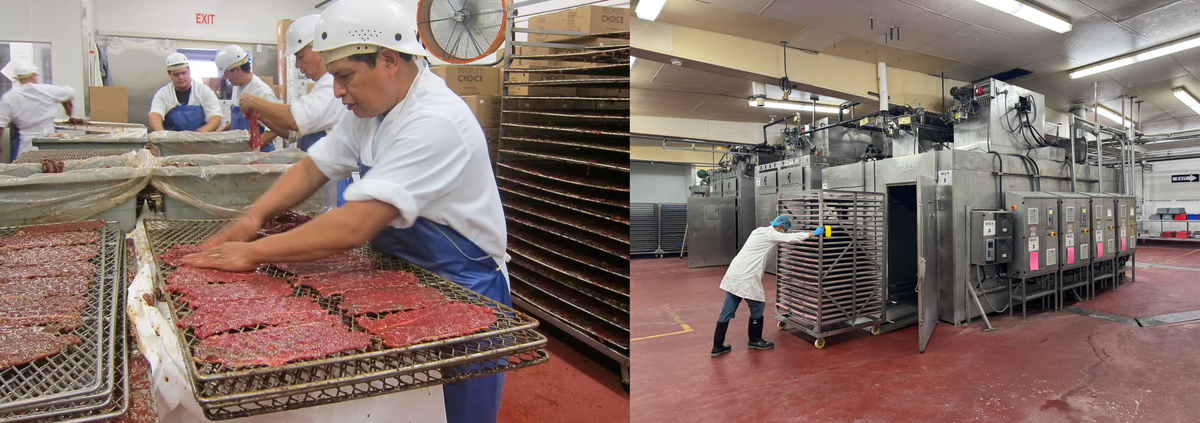
The goal here isn't cooking, it's stopping microbes. Let me let you in on some beef-jerky manufacturing inside information: there's a measurement called water activity (a_w). It captures how viable a food is for bacterial growth, on a scale from 1.00 (pure water) to 0.00 (bone dry). Fresh beef sits around 0.95–0.99 — which is exactly why it's so prone to bacteria, and why you can only leave it out a few hours before it's unsafe to eat.
Carne seca achieves super dry a_w levels through what is known as hurdle technology. Essentially, salt pulls water out by osmosis (fancy word for how water moves toward dry; wet meat → dry salt → less wet meat + more wet salt). Then, the dry-air dehydration drives water activity well below 0.80, the point where meat becomes shelf-stable. At GrazeOn, we quality-check every batch to under 0.40 a_w , the same water activity as whole-egg powder, and drier than most boxed pasta (~0.50). I can't say whether other brands test for a_w, or to what level — but anecdotally, I'd bet the New Mexico crowd dries to a similar level.
Hitting that number takes a commercial or industrial dehydrator running roughly 145–160 °F for 6–10 hours, depending on the thickness of the cut and the seasoning on the meat (our natural flavor, for example, uses very little salt, thus it loses the salt “hurdle” and has to dehydrate longer).
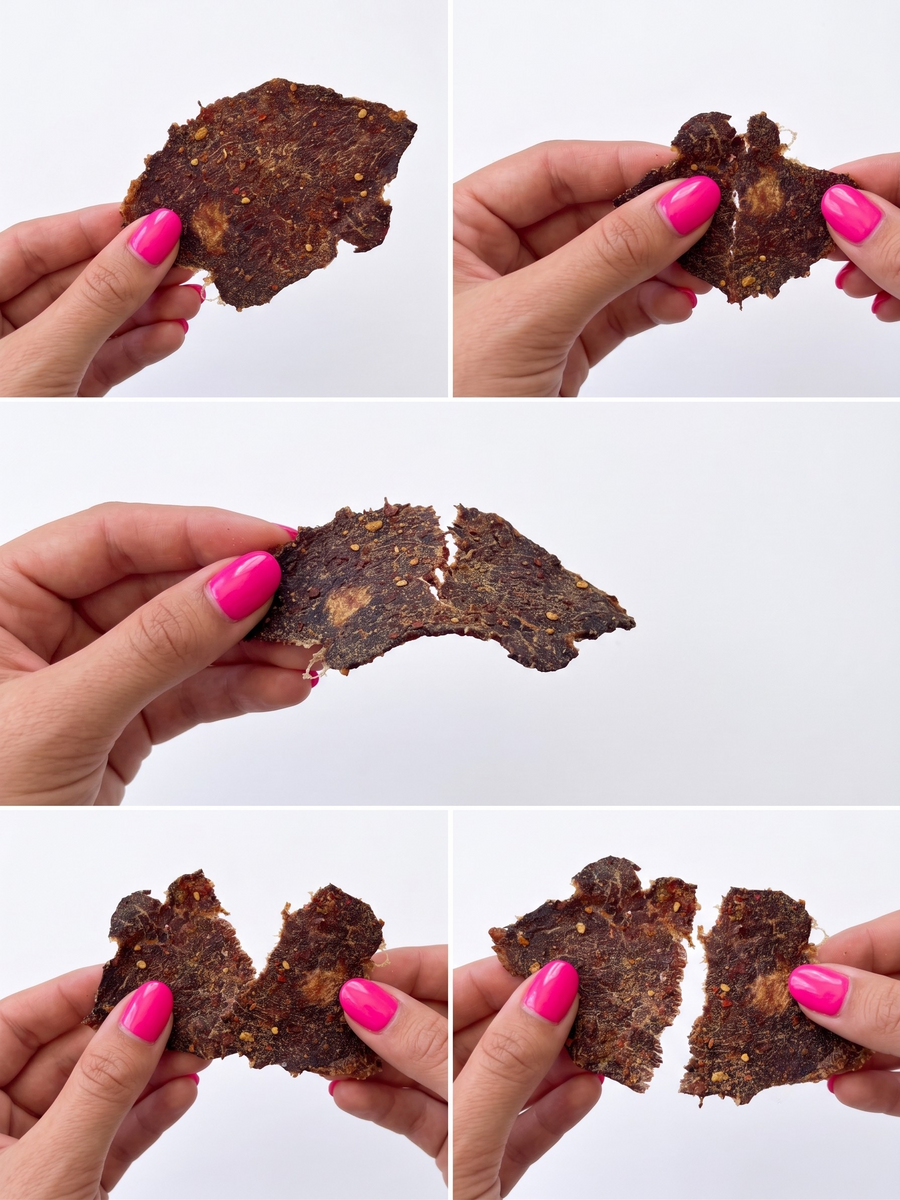
Once the meat is dried, most makers do something called conditioning, a fancy term for tossing it in a bin and letting it rest for 24–48 hours. The idea is to even out whatever moisture is left (not much) so the final texture is consistent. After that, it's bagged, sealed, and sold.
You know the “do not eat” packet in a jerky bag? The one with the little icon of a guy tipping poison into his mouth under a big red X? It's a common misconception that it's silica gel or a desiccant meant to pull water out of the bag. It isn't. Regular jerky holds more water than carne seca and relies on oxygen absorbers, not desiccants, to pull oxygen out of the bag, which is what stops bacteria and mold and keeps the meat from spoiling. Those packets are usually filled with iron powder: expose it to air and the iron starts to “rust” (oxidize), scavenging the oxygen out of the sealed bag and dramatically extending shelf life. The more you know.
Sources:
A note on cost and nutrient density
You think regular beef jerky is expensive? Wait until you get addicted to carne seca. Because ours is dried to a 0.40 water activity, there's barely any water weight left in the bag. One ounce of GrazeOn carne seca starts as about four ounces of raw top round, then add the labor of trimming and prepping, meeting USDA meat-handling standards, and buying quality seasoning, and it's genuinely hard to make the math work as a business. Not to mention beef prices have risen by >%50 since 2020.
What actually matters as a shopper is protein content, not ounce weight, because the same “one ounce” can tell completely different stories for dried beef. A GrazeOn bag has up to 23g of protein per ounce; a gas-station bag might have 6g. GrazeOn runs about $6.00 an ounce, the gas-station bag about $2.00. Both are beef (assuming you bought halfway-decent gas-station jerky) — but the water content makes the cheap stuff heavier and “cheaper” per ounce. Do the math: three ounces of gas-station jerky is 3 × $2.00 = $6.00 for 3 × 6g = 18g of protein… versus 23g in a single GrazeOn ounce, for the same $6.00.
Now... did I pick that exact example and those exact numbers to make my product sound enticing? I did. I definitely did. But it was for explanatory purposes, now you understand that not all jerky is created equal.
The map
One name, many borderlands styles
I coded up a little interactive map so that you can learn about the different regional styles of dried meat in the desert parts of North America. Because carne seca depends on local climate, chiles, and customs, each part of the borderlands built its own version. Hover, tap, or use your keyboard to explore five traditions across northern Mexico and the U.S. Southwest, starting with the New Mexico crisp we make.

Tip: each state's signature dish appears in the panel.
The backstory
Older than the cow: a desert technology
Here's the thing most people get backwards: carne seca is older than the cattle it's made from. The drying came first: an Indigenous desert craft, and the cow showed up later. What we eat today is a synthesis of the two.
An Indigenous craft
Long before Europeans arrived, the people of Aridoamerica (the arid belt covering today's northern Mexico and the U.S. Southwest) had no cattle, pigs, or sheep. None of those animals are native to the Americas. What they did have was game: venison, wild fowl, rabbit, and fish. And they had a problem every pre-refrigeration society faced in a harsh climate: protein spoils within hours in desert heat, yet you need to bank it for lean seasons, blistering summers, and unforgiving winters.
Their solution was the land itself. They sliced meat paper-thin, rubbed it with mineral salts gathered from dry lakebeds, and draped it over branches and rocks to let the sun finish the job. The technique reached beyond red meat, too — the Cucapá people of Baja California made a cecina de pescado, salting fish and curing it paper-thin in the solar heat. Salt, sun, thin slices: every principle of modern carne seca was already in place.
The Spanish brought the cow, not the method
When Spanish colonists pushed into New Spain in the 16th century, they brought enormous herds of hardy, drought-resistant cattle, the ancestors of the longhorn. This was the missing ingredient: not a new technique, but a new, abundant high protein animal. The Spanish carried a deep Iberian pastoral tradition, so they knew herding; what they didn't need to teach was how to preserve meat without ice. The existing Indigenous knowledge of salt-curing and sun-drying was simply pointed at a far larger source of protein, and beef-based carne seca was born.
Why the desert made it inevitable
It's worth sitting with how perfectly suited the borderlands are to this. In the Sonoran and Chihuahuan deserts, the same conditions that make fresh meat impossible to keep (relentless heat, intense sun) are exactly the conditions that dry it fastest. Low humidity wicks moisture out before bacteria can take hold; salt flats sit within reach; firewood is scarce, so drying beats smoking or cooking over a fire. Carne seca turned the climate from an enemy into a preservation engine. It wasn't a quaint tradition so much as the single most rational thing you could do with meat in that environment.
The vaquero's pocket fuel
By the 18th and 19th centuries, ranching ruled the vast spreads of Sonora, Chihuahua, Texas, and California, and managing those free-roaming herds created the vaquero — the original cowboy. Vaqueros spent weeks on horseback across country that would rot fresh meat in an afternoon, so they needed food that was light, calorie-dense, and unspoilable. Carne seca was the staple. On the trail they'd butcher a steer, cut the muscle into long strips, dip them heavily in brine, hang them on lines, and turn them constantly so the sun dried them through before they could spoil. When Anglo-American settlers moved into Spanish Texas after 1821, they didn't just borrow the gear and the lexicon like the lasso, corral, and rodeo, they adopted the ultra dried beef too.
The tradition traveled further than the mainland. In the 1830s, Mexican vaqueros were hired to tame Hawaiʻi's feral cattle and became the islands' paniolo — a Hawaiian rendering of español. Their dried beef became pipi kaula, or “beef rope,” still eaten in Hawaiʻi today.
Fun fact
Carne seca might soon be "protected" — like Champagne
Ever notice that sparkling wine can only be called Champagne if it comes from the Champagne region of France? That's a protected designation of origin at work — a legal rule that locks a product's name to a specific place and a specific traditional method. Make the identical drink in California and you're legally required to call it “sparkling wine.” The same protection guards Parmigiano-Reggiano, Roquefort, Tequila, and Mezcal. Mexico runs its own version called a Denominación de Origen (DO), administered by the country's industrial-property institute, IMPI.
Why does it matter? A designation like this does three things at once: it shields a regional heritage product from cheap imitations, it legally guarantees the method and the origin (so the word “authentic” actually means something), and it can lift an entire local economy by letting genuine producers charge a premium. It's cultural protection with real economic teeth.
Here's the fun part for carne seca lovers: it's on track to join that club. On March 19, 2026, the Mexican Senate unanimously approved an amendment to Article 12 of the General Law of Culture and Cultural Rights, and Senator Lorenia Valles Sampedro announced that carne seca and the wild chiltepin pepper could obtain protected status. (Press coverage.) Sonora already holds one such designation — for the agave spirit bacanora — so carne seca would be in good company.
As of mid-2026 the designation is not finalized — so be wary of any product claiming it already carries one. To become binding, IMPI still has to complete its geographic and historical audits and publish an official declaration in Mexico's federal register.
Questions
Carne seca, answered
Is carne seca the same as beef jerky?
Not quite. American jerky is usually built on sweet liquid marinades and liquid smoke and kept pliable. Carne seca is cured with little more than salt and dried harder. New Mexico-style carne seca, like GrazeOn, is seasoned and dried thin until it's crispy and snaps under pressure.
Is carne seca the same as machaca?
They're the same meat in different states. Carne seca is the whole dried strip; machaca is that strip pounded or shredded into fine fibers. Machacado con huevo is the finished dish of rehydrated machaca scrambled with eggs.
How do you eat carne seca?
It depends on the region. In much of northern Mexico and in Arizona it's rehydrated, shredded, and cooked into eggs, stews, tacos, and chimichangas. In New Mexico it's kept dry and brittle and eaten as a seasoned snack.
Is GrazeOn carne seca?
Yes. GrazeOn Beef Crisps are New Mexico-style carne seca: lean beef sliced thin and air-dried until crispy, then seasoned. Every batch is dried to a water activity of 0.40 or lower, with up to 23g of protein per ounce, zero sugar, and zero carbs.
Why is carne seca so expensive?
Drying removes most of the meat's weight — often three-quarters of it. Dried as far as a crispy carne seca, a pound of trimmed lean beef can shrink to roughly a quarter-pound. That shrinkage, plus the labor of trimming away all fat, is why it costs what it does.
¿Qué es la carne seca, y cómo se dice en inglés?
Carne seca es carne de res salada y secada al aire hasta quedar crujiente — literalmente, "dry meat" in English. In English it's usually translated as dried beef or beef jerky, though true carne seca is sliced thinner and dried harder than most American jerky. GrazeOn Beef Crisps are made in that same New Mexico style.
About the author
Citations
Sources & further reading
Everything here is grounded in primary research, food-science references, and reporting. Here's where the claims come from.
- KSU ExtensionGetty, K., & Gaikwad, R. (2024). Water activity of foods (MF3674). Kansas State University Research and Extension. — bookstore.ksre.ksu.edu
- NIH · PMCCichello, S. A. (2015). Oxygen absorbers in food preservation: A review. Journal of Food Science and Technology, 52(4), 1889–1895. — pmc.ncbi.nlm.nih.gov
- USU ExtensionUtah State University Extension. (2011). Oxygen absorbers [Extension publication]. Utah State University. — digitalcommons.usu.edu
- YouTube · SciShowSciShow. (n.d.). What is the packet inside beef jerky bags? [Video]. YouTube. — youtube.com
- Lee's Market JerkyLee's Market Jerky. (n.d.). What is the packet inside beef jerky? Lee's Market Jerky Blog. — leesmarketjerky.com
- Proyecto PuenteProyecto Puente. (2026, March 19). La carne seca y el chiltepín tendrán denominación de origen, anuncia Lorenia Valles. Proyecto Puente. — proyectopuente.com.mx
- FAOFood and Agriculture Organization of the United Nations. (n.d.). Dried salted meats: Charque and carne-de-sol. FAO Animal Production and Health Papers. — fao.org
- SciELO · CTADias, V. H. de L., Dantas, T. D., Ferreira, V. C. da S., Sousa, S. de, Almeida, J. L. S. de, Saraiva, M. M. T., Alves, R. do N., Figueiredo, C. F. V. de, Oliveira, A. G. de, Chiodi, J. E., Oliveira, F. F. D. de, & Ribeiro, N. L. (n.d.). Salting in the preparation of jerked beef. Ciência e Tecnologia de Alimentos. — scielo.br
- USDA FSISU.S. Department of Agriculture, Food Safety and Inspection Service. (2014). FSIS compliance guideline for meat and poultry jerky produced by small and very small establishments. — fsis.usda.gov
- NMSU ExtensionNew Mexico State University. (n.d.). Beef jerky processing. NMSU Extension Food Technology Lab. — foodtech.nmsu.edu
- Larousse CocinaLarousse Cocina. (n.d.). Cecina [Encyclopedia entry]. Larousse Cocina. — laroussecocina.mx
- Tucson FoodieTucson Foodie. (2025, May 2). From rooftops to restaurants: Tucson's carne seca legacy. Tucson Foodie. — tucsonfoodie.com
- Residente MXResidente. (n.d.). La receta que conquistó a México nació en Ciénega de Flores. Residente. — residente.mx
- GrokipediaGrokipedia. (n.d.). Carne seca [Encyclopedia entry]. Grokipedia. — grokipedia.io
- El VigíaAgencia Reforma / El Vigía. (n.d.). El ABC de la carne seca. El Vigía. — elvigia.net
- Vigil's Beef JerkyVigil's Beef Jerky. (n.d.). What is carne seca? Vigil's Beef Jerky. — vigilsbeefjerky.com
- eScholarship · UCUniversity of California. (n.d.). Spanish and Mexican ranching in the Southwest: Vaquero culture and cattle drives. eScholarship, University of California. — escholarship.org
- Terra Patre FarmsTerra Patre Farms. (n.d.). The vaquero: Iberian and colonial origins of the American cowboy. Terra Patre Farms. — terrapatrefarms.com
- Rio Grande GuardianRio Grande Guardian. (n.d.). Vaquero reflects heritage of South Texas. Rio Grande Guardian. — riograndeguardian.com
- Kawaiola NewsKawaiola News. (n.d.). Paniolo: The pride of a nation. Kawaiola News. — kawaiola.news
- The Roaming BoomersThe Roaming Boomers. (2026). Tucson's El Charro Café: Nation's oldest Mexican restaurant. The Roaming Boomers. — theroamingboomers.com
- El Imparcial · SonoraEl Imparcial. (2026, March 20). Con Plan México, carne seca de Sonora podría obtener denominación de origen. El Imparcial. — elimparcial.com
- Canal SonoraCanal Sonora. (2026, March 19). Carne seca y chiltepín sonorenses tendrán denominación de origen. Canal Sonora. — canalsonora.com.mx
- TelediarioTelediario. (n.d.). Machacado con huevo: El legado de Ciénega de Flores. Telediario Monterrey. — telediario.mx
Welcome to the herd
Taste the New Mexico style
Now you know what carne seca is — try the crispy kind. High protein, zero sugar, made in the USA.